
A student desk can be used for almost everything: essays, research, spreadsheets, online classes, browsing, media, and personal projects. That variety favors peripherals that are versatile rather than narrowly specialized. The SABLUTE Wireless Mechanical Keyboard and Mouse Combo combines a 104-key mechanical keyboard with a six-button wireless mouse, both connected through one 2.4GHz receiver. The keyboard includes linear red switches, round typewriter-style keycaps, customizable backlighting, a multifunction knob, a 5000mAh rechargeable battery, and USB-C wired operation. Its appearance is more decorative than a basic school or office keyboard, but its layout remains conventional and complete. This review looks at how the set fits a study space and where its strengths and limitations matter for students using a desktop or laptop as a primary computer.
A study desk that feels more personal than the typical campus setup
The SABLUTE keyboard makes its strongest visual statement through its round typewriter-style keycaps. They are ABS keycaps with decorative electroplated rings, arranged across a full 104-key keyboard and paired with a metal top panel. The effect is deliberately modern-retro: the board references the visual character of a vintage typewriter while keeping the functions expected from a contemporary desktop keyboard. That balance is important to the product’s positioning. This is not being presented as a high-end custom mechanical keyboard with enthusiast construction claims. Instead, the appeal is simpler and more mainstream: a keyboard that looks more interesting than a generic office board while still providing a full number pad, function row, arrow keys, and navigation controls. For aesthetic home offices, student desks, and creative workspaces, that formula is easy to understand. For students who care about how their workspace looks, it can also function as an aesthetic keyboard while still keeping the familiar keys needed for coursework.
Red switches make notes, essays and messages feel distinctly mechanical
Typing is handled by linear red mechanical switches. The supplied specifications describe a smooth, relatively light keystroke without a tactile bump, which makes the switch style approachable for people coming from ordinary office keyboards or trying a mechanical keyboard for the first time. The switch lifespan is listed at approximately 50 million keystrokes. That does not turn the SABLUTE into an enthusiast-grade mechanical keyboard, and it should not be marketed that way. The more accurate positioning is an accessible mechanical typing experience for everyday work, study, writing, and general computer use. Linear switches also create a simple, predictable key feel because the press is not interrupted by a tactile bump. Users who specifically want a clicky or strongly tactile response should note that this product is not designed around that sensation. Its mechanical appeal is centered on smoothness, familiarity, and everyday usability rather than specialist tuning or custom-keyboard features.
Full-size keys for assignments, calculations and everyday shortcuts
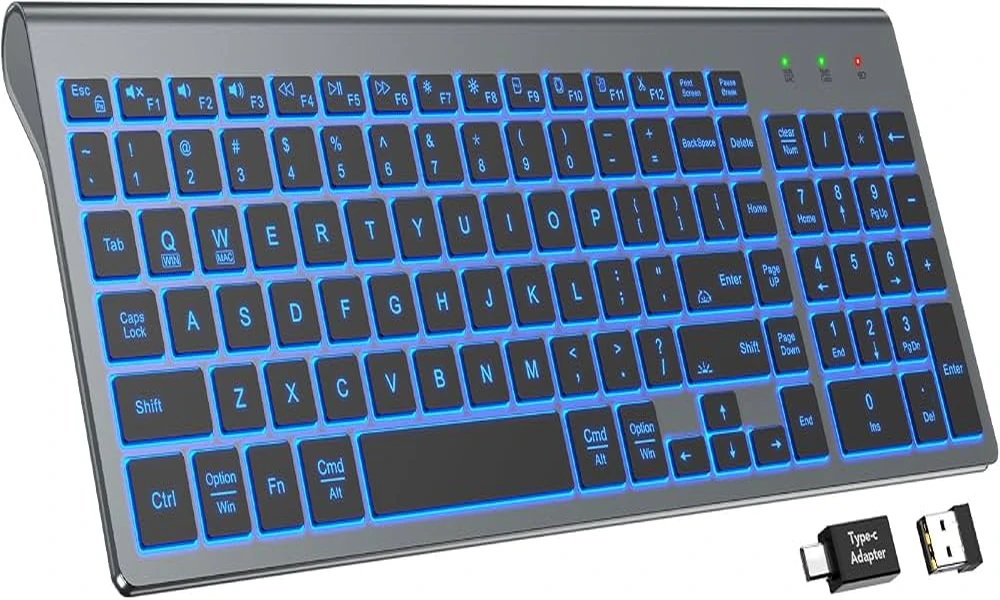
Full-size keyboards remain useful for a simple reason: every major key group is available immediately. SABLUTE’s 104-key layout retains the numeric keypad, function row, arrows, navigation keys, multimedia functions, and a dedicated calculator shortcut. That is particularly relevant for users who work with spreadsheets, accounting-style number entry, office software, or any task where repeated access to numbers and navigation keys matters. The multifunction control knob adds another layer of convenience by handling common adjustments without replacing the conventional key groups. Rather than chasing compactness, this keyboard prioritizes completeness. It is therefore better suited to a desk where the keyboard can stay in place than to a minimalist travel setup. For home offices and study areas, however, the larger format can make daily work more direct because familiar controls are exactly where most users expect them to be.
One receiver helps keep a student desk less cluttered
For most desktop users, connectivity needs to be dependable more than complicated, and SABLUTE follows that idea. A single 2.4GHz USB receiver connects both devices in the set, meaning the mouse does not require its own separate dongle. A single 2.4GHz USB receiver connects both the keyboard and mouse from up to 26 ft (8 m) under suitable conditions. The keyboard also includes USB-C wired functionality and can be used while it charges, which is useful if power runs low during the day. The main purchasing consideration is Bluetooth: there is none. Users should not expect tablet-style Bluetooth pairing, multi-device Bluetooth switching, or a three-mode connection system. Instead, the combo is built around a conventional USB receiver for wireless use and a USB-C cable for the keyboard. For a home office or fixed desk, that can be refreshingly uncomplicated.
Backlighting for late-night study without turning the keyboard into a gaming claim
SABLUTE gives the keyboard more lighting flexibility than a basic single-color office board, but it keeps the system accessible. There are 17 backlighting effects, seven selectable single colors, extra RGB effects, and up to 108 combinations according to the supplied specifications. Lighting controls live on the keyboard itself, with the multifunction knob providing convenient access to backlight settings and brightness. That is useful for users who want immediate adjustments without opening an application. The correct description, however, is customizable backlighting rather than per-key RGB. There is no stated support for individually addressable keys or software-based RGB control. The feature is best appreciated as a built-in visual layer that complements the retro keycaps and can be changed or turned off depending on the room, time of day, or preferred desk style.
Quick controls between lectures, music and study sessions
SABLUTE’s multifunction knob gives users a tactile shortcut for two frequently changed settings. In its audio role, the knob changes volume with a turn and toggles mute with a press. In its lighting role, it helps adjust backlight settings and brightness. The implementation is intentionally simple and does not depend on software. That fits the product’s mainstream focus: everyday controls should remain accessible directly from the hardware. The knob is not the headline feature, but together with the full-size layout it contributes to a keyboard that is clearly designed to stay on a primary work desk.
Rechargeable power and automatic sleep for an irregular schedule
Power comes from a built-in 5000mAh rechargeable battery, charged through USB-C. The keyboard can continue to be used while it is charging, which reduces the practical downside of a depleted battery. SABLUTE also includes automatic power-saving behavior: the backlight turns off after roughly two minutes of inactivity, and the keyboard enters sleep mode after about ten minutes. Pressing a key wakes it again. With the backlight turned off, the supplied estimate reaches up to approximately 1,000 hours of use, though actual battery life varies with lighting, typing frequency, wireless conditions, and other factors. That caveat is important because no single battery-life number can describe every real-world setup. The larger point is that SABLUTE combines a sizable rechargeable battery with power management designed for everyday wireless use, while preserving wired operation whenever charging is necessary.
Using the same keyboard with Windows or a Mac laptop
The keyboard includes a dedicated Mac mode with switchable Windows and Mac key mapping. In Mac mode, the bottom-row modifier keys are remapped to the familiar Control, Option and Command arrangement, while the function row provides macOS-oriented system, media and productivity shortcuts. The Mac function row is designed for macOS but is not identical to the standard Apple function row: F10-F12 are assigned to Copy, Paste and Select All rather than Apple’s usual audio controls. The dedicated calculator key is not available on macOS.
The included mouse covers research, browsing and general navigation
The combo packaging means buyers do not have to treat the mouse as an afterthought. SABLUTE supplies a six-button wireless mouse that shares the keyboard’s 2.4GHz USB receiver. It includes forward and back side buttons and four DPI selections – 800, 1200, 1600, and 2400 – so users can adjust pointer speed for different preferences. The left and right clicks are designed to be quiet. That makes the mouse suitable for ordinary office work, browsing, and study use, while its matching design helps keep the workstation visually coordinated. The keyboard is still the more distinctive product, but the mouse adds practical value to the package.
From coursework to downtime: where the combo fits a student routine
The single-receiver design is particularly useful on laptops, where USB ports can be limited. One dongle connects both keyboard and mouse, leaving other ports available for storage, charging, displays, or accessories. The full-size board is helpful when coursework involves spreadsheets, statistics, accounting, or any subject that uses repeated number entry. Writers benefit from the familiar arrow and navigation keys, while the function row and multimedia controls remain easy to reach. Backlighting can make the board easier to use in a dim room and can also personalize the study setup, but it can be shut off to preserve battery. Automatic sleep behavior helps when the user leaves the desk between classes or study sessions. The main limitation is Bluetooth. Students who want one keyboard to switch wirelessly among a laptop, tablet, and phone may prefer a different device; students using one primary computer can take advantage of the simpler receiver-based setup.
Before buying for school, know these practical limitations
A balanced review also needs to be explicit about the features that are not part of this product. The keyboard does not support Bluetooth and should not be described as tri-mode. The supplied specifications do not include hot-swappable switches, a gasket mount, PBT keycaps, per-key or individually addressable RGB, software-controlled RGB, Hall Effect or magnetic switches, Rapid Trigger, adjustable actuation, ultra-low-latency gaming claims. It is also not positioned as a professional gaming, premium enthusiast, custom, silent, or ergonomic keyboard. These are not small wording details: they define the category in which the SABLUTE combo should be judged. Buyers who require one of those specialist features should choose a product designed specifically around that need. Buyers who do not need them can focus instead on the SABLUTE’s actual strengths: full-size productivity, accessible mechanical switches, distinctive styling, simple wireless setup, rechargeable power, onboard lighting, and the convenience of a matching mouse.
A complete study-desk package with more personality than basic peripherals
For a student workstation, the SABLUTE combo offers a useful blend of practicality and personality. The keyboard can handle writing, research, data entry, and everyday computing without the compromises of a compact layout, while the mouse completes the setup without requiring a second receiver. Mechanical red switches and retro keycaps make the desk feel more distinctive than a standard bundle, and onboard lighting adds customization without extra software. The set is best suited to a fixed study space rather than a highly mobile multi-device routine. If that matches the student’s workflow, the combination of full-size controls, rechargeable power, and coordinated wireless peripherals is easy to justify.
Students who want a more distinctive study setup may be drawn to a round keycap keyboard like this because the retro-inspired design adds personality without changing the familiar full-size arrangement.
