
The Obligation That Does Not Disappear With the Device
Data destruction is not a technical afterthought. It is a commitment, and the cost of failing to honour it falls not on the institution that failed, but on the individuals whose information was left exposed. Think about what a decommissioned laptop contains. Financial records. Employee data. Client correspondence. Medical history. The private details of people who trusted an organisation with their information. When that device is retired without proper data destruction, that trust is broken, often without anyone inside the organisation ever knowing it happened.
Understanding What Data Destruction Actually Means
There is a tendency to conflate deletion with destruction. They are not the same. Deleting a file removes it from the directory structure of an operating system. The underlying data remains on the storage medium, intact and recoverable. Formatting a drive achieves a similar incomplete result. Even a drive that appears blank to a casual user may yield a complete archive of sensitive information to anyone equipped with basic forensic software.
Secure data destruction means rendering that information irrecoverable through methods that have been verified, certified, and documented. The principal methods in use today include:
Data overwriting
Certified software rewrites every sector of the storage medium with random data, typically across multiple passes, to a recognised standard such as NIST SP 800-88
Degaussing
A powerful magnetic field disrupts the magnetic domains that store data, rendering the medium unreadable. This method is effective but permanently disables the device
Physical destruction
The storage medium is mechanically shredded, crushed, or disintegrated, making recovery physically impossible. This is the standard for the most sensitive data environments
Cryptographic erasure
Encryption keys are destroyed, rendering encrypted data permanently inaccessible without physical damage to the device
The choice of method depends on the sensitivity of the data involved, the intended fate of the hardware, and the regulatory context in which the organisation operates.
Singapore’s Legal Framework
Singapore’s Personal Data Protection Act (PDPA) places explicit obligations on organisations to protect personal data throughout its entire lifecycle. That lifecycle includes the point of disposal, a fact that organisations focused on data collection and storage sometimes overlook entirely.
The Personal Data Protection Commission (PDPC) has been unambiguous on this point. It has stated that “organisations should put in place proper procedures for the disposal and destruction of personal data and the storage media on which the data is stored.” Non-compliance carries the risk of financial penalties and, significantly, the public disclosure of data breaches, a consequence that carries its own reputational weight.
Environmental obligations reinforce the data protection framework. The National Environment Agency (NEA) advises that “businesses should engage licensed e-waste recyclers to ensure that electrical and electronic equipment is properly collected and treated.” A comprehensive data and media destruction programme addresses both requirements, producing the documentation needed to satisfy regulatory inquiry on either front.
Standards That Provide the Benchmark
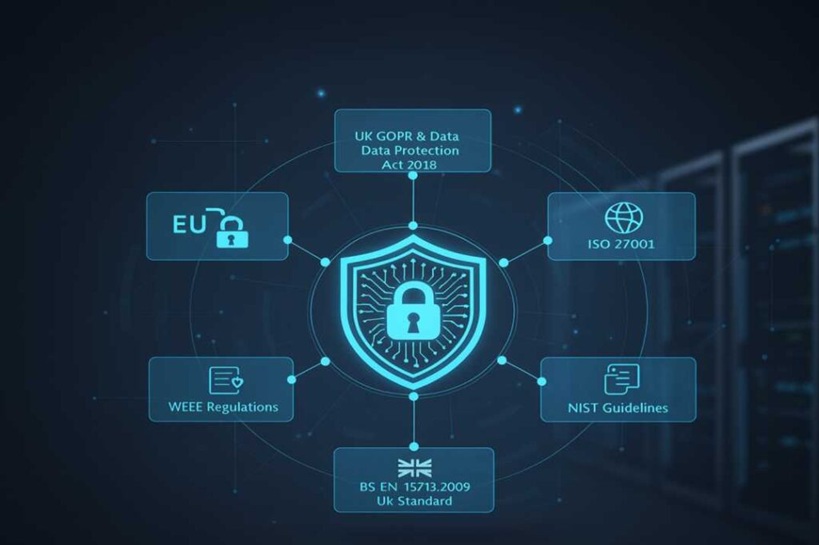
Responsible destruction of data does not operate in a vacuum. It operates against a set of internationally recognised standards that define what effective sanitisation looks like and what documentation it generates. The most relevant frameworks include:
NIST SP 800-88
Guidelines for media sanitisation, widely adopted as the benchmark for overwrite-based data destruction across regulated industries globally
ISO 27001
The international standard for information security management, which incorporates requirements for the secure handling and disposal of storage media
DoD 5220.22-M
A data erasure specification originating from the United States Department of Defense, used in environments where classified or sensitive government information is involved
Adherence to these standards does two things. It ensures that destruction is genuinely effective. And it provides the kind of documented evidence that regulators, auditors, and clients increasingly expect to see.
The Chain of Custody Principle
One element of certified data destruction that organisations sometimes underestimate is chain of custody. From the moment a storage device is decommissioned to the moment it is destroyed, every transfer of physical possession is a vulnerability. A device passing through multiple hands, without proper documentation and controls, is a chain waiting to break.
Best practice requires organisations to maintain a complete record covering:
- Device inventory at the point of decommissioning, including serial numbers and data classifications
- Transfer documentation at each stage of the disposal process
- Witnessed or third-party certified confirmation of destruction
- Retention of destruction certificates as part of the organisation’s compliance records
These records serve a practical purpose in the event of a breach investigation. They also serve a broader one: they demonstrate that the organisation took its responsibilities seriously, at every stage, without exception.
What Best Practice Looks Like in Action
For organisations seeking to establish or improve their data destruction and disposal processes, the following principles provide a reliable foundation:
- Establish a formal policy that defines data classification levels and the corresponding destruction method required for each
- Ensure that destruction is certified to a recognised standard and that documentation is issued upon completion
- Apply chain of custody controls from decommissioning through to final destruction or sanitisation
- Verify that third-party providers hold the necessary licences and accreditations to operate within Singapore’s regulatory framework
- Conduct regular audits of disposal processes to identify gaps and ensure ongoing compliance
Conclusion
The individuals whose data an organisation holds did not choose to expose themselves to risk when a server reached the end of its useful life. They chose to trust an institution. Honouring that trust, when it is no longer convenient or commercially obvious to do so, is the measure of genuine accountability. In Singapore’s regulatory environment, where the PDPA and the PDPC set a clear and enforceable standard, that accountability is also a legal obligation. Meet it fully, document it rigorously, and build it into every stage of your technology lifecycle through robust and certified data destruction.
