
There is no shortage of options. Every second vendor claims their platform is the most advanced, the easiest to deploy, and the best fit for your specific needs. The noise makes a straightforward decision unnecessarily complicated.
The reality is simpler than the market makes it sound. Choosing the right AI virtual assistant comes down to two things: what your business actually needs right now, and what it is likely to need twelve months from now. Everything else is secondary.
This is where most evaluations go wrong. Teams get pulled into feature comparisons before they have established what scale of solution the business can realistically absorb and maintain.
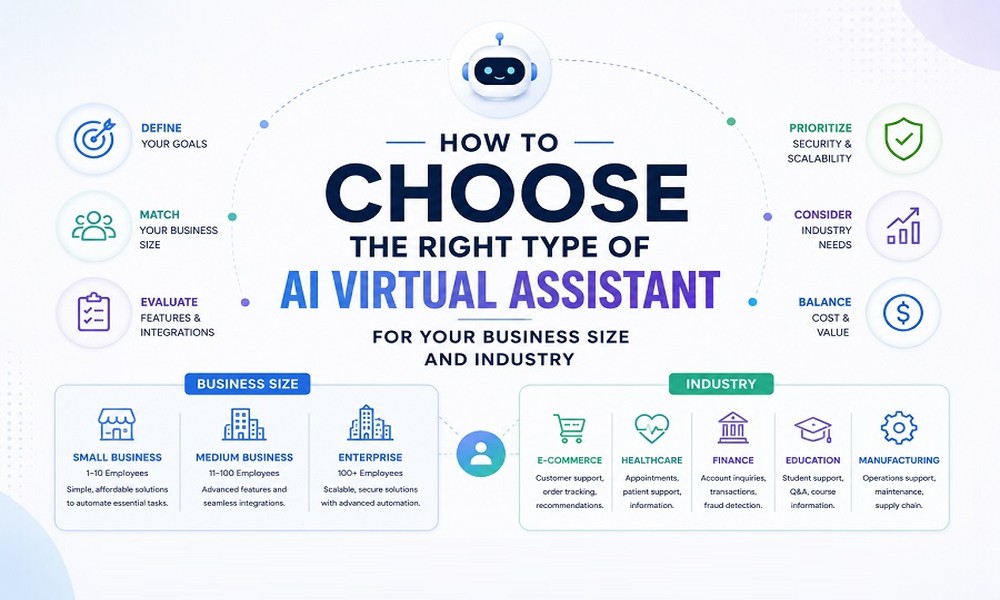
A ten-person startup and a five-hundred-person enterprise are not shopping for the same thing – even if both are looking at the same category of tool.
For smaller businesses, the priority is usually speed to value. A lightweight AI virtual assistant that handles the top twenty customer queries reliably is more useful than a sophisticated platform that takes six months to configure and requires a dedicated team to manage. Complexity kills adoption at smaller scale.
For mid-size and enterprise businesses, the calculus flips. A tool that cannot integrate with existing CRM systems, cannot handle high concurrent volumes, and cannot be customised for specific workflows will hit its ceiling fast. Here, the right question is not “can we get it running?” but “can it scale with us without being rebuilt?”
Industry Shapes the Requirements More Than Most Realise
Two businesses of identical size can have very different requirements from an AI virtual assistant – purely because of the sector they operate in.
A fintech company dealing with payment failures, KYC queries, and loan status checks needs a system that can pull live data, handle sensitive information carefully, and escalate with precision. A wrong or delayed response in that context has real financial consequences for the customer.
An e-commerce brand handling order tracking, return requests, and product queries has different pressure points entirely. Volume is the primary concern. The system needs to handle thousands of simultaneous conversations without degradation in response quality.
A healthcare platform has its own set of constraints – accuracy, tone, and the ability to recognise when a query needs immediate human attention rather than an automated response.
The AI virtual assistant that works well in one of these environments may be genuinely wrong for another. Industry fit is not a marketing consideration. It is an operational one.
The Integration Question You Need to Answer Early
One of the most common mistakes businesses make is evaluating an AI virtual assistant in isolation – judging it purely on conversation quality during a demo, without asking how it connects to the rest of the stack.
A virtual assistant that cannot talk to your order management system, your CRM, or your helpdesk platform can only answer questions. It cannot resolve anything. And customers increasingly expect resolution, not just information.
Before committing to any platform, map out which integrations are non-negotiable for your use case. Then verify – not through the sales deck, but through a technical conversation – whether those integrations exist, how they work, and what customisation is required.
This single step eliminates a large portion of options quickly, which actually makes the decision easier.
Language and Regional Fit in the Indian Context
This does not get enough attention in most vendor evaluations.
India’s customer base is not homogeneous. Depending on the geography you serve, your AI virtual assistant may need to handle queries in Hindi, Tamil, Telugu, Marathi, or some combination of these mixed with English. A system trained primarily on English-language data will underperform in these interactions – sometimes badly.
Ask specifically how multilingual support is built into the model, not just whether it exists as a feature on the pricing page.
A Simple Framework Before You Decide
Before signing anything, get clear answers to four questions. How many concurrent conversations does the system handle reliably? What does the escalation path look like when the assistant cannot resolve a query? How is the system updated as your products, policies, or workflows change? And what does the onboarding and ongoing support structure look like?
The answers will tell you more than any demo will.
